


The biggest news yesterday was Meta charging for AI for the first time. On July 9th, Meta released Muse Spark 1.1, an agentic coding model out of its Superintelligence Labs, and opened its first paid developer API, which puts it in direct competition with Anthropic and OpenAI rather than just shipping open weights the way it did with Llama. Mark Zuckerberg broke a three-year silence on X to announce it, and the whole pitch is price. Meta set it at $1.25 per million input tokens and $4.25 per million output tokens, which it frames as a fraction of what the comparable OpenAI and Anthropic models cost. It is not the best model on the board, and Meta more or less admits that, since it trails Opus 4.8 and GPT-5.5 on pure coding, but it leads on the agentic and tool-use benchmarks and it undercuts almost everyone on cost.
What makes this work for Meta is that they own the whole stack. They have the hardware, the data centers, and the engineers, so they can run this on thin margins, steal some market share, and be the cheaper option while they climb toward the top tier. They also rolled out a new image model, Muse Image, a couple of days earlier, so there is a lot coming out of the Superintelligence Labs team that Alexandr Wang now runs after Meta bought Scale AI. If it works, this is a new revenue stream for Zuckerberg, and one of the bullish things here is that Meta does not really get hurt in this fight because they already own the infrastructure to build it.
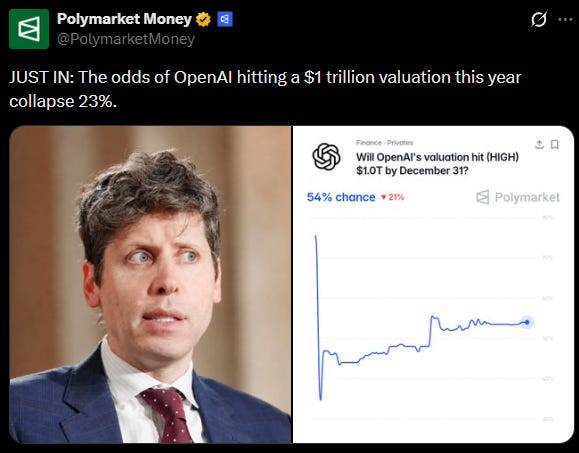
However, if someone like Meta can show up late and undercut everyone in price, then the frontier lab models keep looking more like a commodity. You now have Grok 4.5 from SpaceX, GPT-5.6 from OpenAI, and all the Chinese open weight models nipping at frontier, and now a cheap Meta option. If OpenAI and Anthropic were publicly traded, I think their valuations would get hit on these headlines almost eery single day. So the question I continue to have is, is AI just commoditizing into the same agentic AI product? And is this really the most important question right now for long-term investors in hyperscalers?
It all comes down to 2028 Free Cash Flow
Torsten Slok, the chief economist at Apollo, put out a note this week showing that the four big hyperscalers, Google, Meta, Microsoft, and Amazon, are all projecting a massive acceleration in free cash flow by 2028. Consensus has their combined free cash flow more than doubling over the next few years. The reason they are all pointing at the same year is that this is when the data center build-out is supposed to mature, or “taper off.”
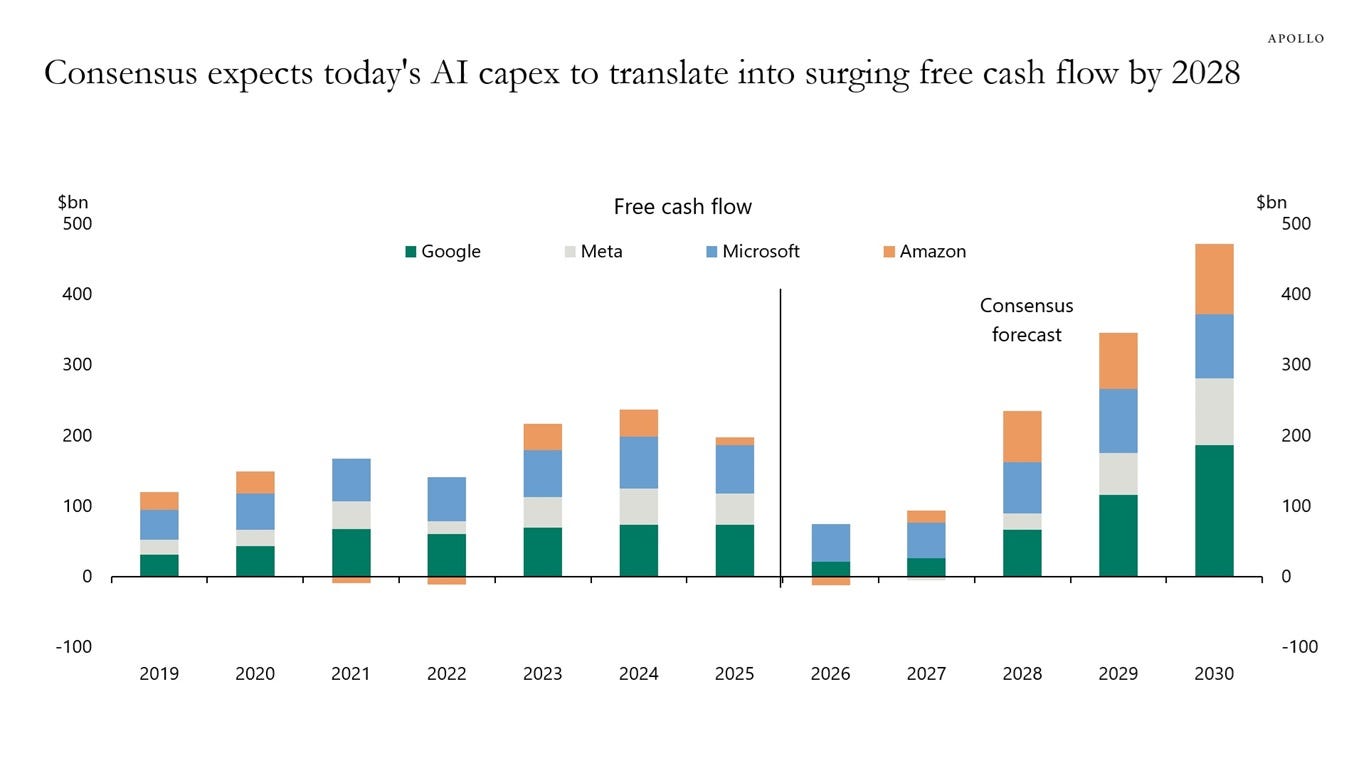
Amazon and Google are the biggest part of that recovery on the chart, with Amazon in particular set to put up some of its largest free cash flow ever by 2028. That is the entire game plan, to repeat a similar cloud buildout as the mid-2000s. Drown in capex for a few years, then harvest the free cash flow and buy back shares.
There are a few ways the buildout could go wrong, and I think the first one is that the build-out never really ends. You always need the next GPU, the next memory cycle, the next rack of hardware, so the capex never tapers the way these charts assume, and these light-asset software companies officially become heavy-asset industrials that never get to buy back shares again. That is the shitty scenario number one.
The second is the one Slok himself flags, which ties back to the Meta story. If token prices keep falling and cheaper Chinese open source models keep taking share, the AI payoff could simply arrive later than 2028 while the committed capex and the heavy depreciation hit right on schedule. This would obviously squeeze margins, free cash flow charts would still look ugly, and the hyperscalers would pull down the major indices. This would likely spread to chips, power, data centers, private credit, financials, etc. It’s my opinion this is s more realistic bear case if there was one, and it’s the commodization story that has always been a bit concerning to me.
As we begin to enter earnings season next week, investors will be reminded that we cannot cleanly seperate what is AI revenue versus what is not. When Meta uses its own AI to show you better ads and you spend more, that shows up inside advertising revenue rather than a line item called AI. When the cloud blacklogs-RPOs at the hyperscalers balloon, everyone knows that is AI demand, but it does not get broken out as AI cloud revenue either. Yes, it is obvious that AI is fueling growth, with more demand than they have compute to serve.
When earnings roll in this month, I’m less interested in some invented AI revenue segment and more interested in whether the free-cash-flow trajectory points to a 2028 payoff.
The Rigatoni Capital Podcast is now on YouTube, Spotify, Apple Podcasts, Amazon Music, and iHeart Radio.
In Other Market News
Starbucks is now building its own software in-house with AI to replace applications it buys from Microsoft and IBM, specifically a Microsoft inventory system and an IBM maintenance tool. This is the software terminal-value fear in one story, and the market reacted, with Microsoft down about 2.4% and IBM down about 5.2% on the news. Starbucks spends roughly $400 million a year on software and is trimming about $30 million from its tech budget this fiscal year on the way to a broader $2 billion cost-cutting target. If an old-economy brick-and-mortar company can start building its own tools now that AI makes it possible, that is a real threat to the software vendors, and it is worth watching whether this becomes a trend rather than a one-off.
On AG-food, the strongest El Niño in 75 years is setting off supply chain alarm bells, with forecasters giving it a 97% chance of lasting into early 2027, which means the worst of it may not have even hit yet. This is my day job on the brokerage side, so I will say plainly that the crop damage is real. We have had frost that killed a lot of the crop in the Upper Midwest and even down here in the Mid-Atlantic, along with drought in places like California, and we are looking at something like 50% lower yields on certain items, which is enormous. That is core food inflation, the kind the Fed can do nothing about, the same way it cannot control a war or the price of oil.
On that note, do not buy the headline that Walmart is lowering food prices because they are being friendly. Yes, they are technically lowering prices on certain items, but you cannot run a grocery business by cutting prices across the board. What they are doing is taking a little less margin on a few high-traffic items, like fresh cherries, to pull more foot traffic into the stores. The Montmorency tart cherry crop out of Michigan got destroyed this year, but the fresh cherries in the produce aisle come from the West Coast, and that is exactly the kind of item Walmart will work on thin margins because everybody buys them. It is strategic, it makes them look good politically, and they already got the tweet from Trump, but if you think it signals a real trend in food prices coming down, I think you are way off.
And Netflix is exploring live TV channels and bundles as its engagement slips, with its share of US TV viewership falling to 7.8% in April, the lowest since May 2025. The stock is down more than 40% over the past year after its failed run at Warner Bros. Discovery. I own Netflix and I am not selling on this, but I will admit the content quality has slipped, and a pivot into live TV is not the update a long-term shareholder wants to hear. However, I would advise you to subscribe to Accrued Interest (Simeon M.) as the expert on TV-streaming stocks like Netflix, and I hope to have him on the podcast again in the near future.
Final Thoughts
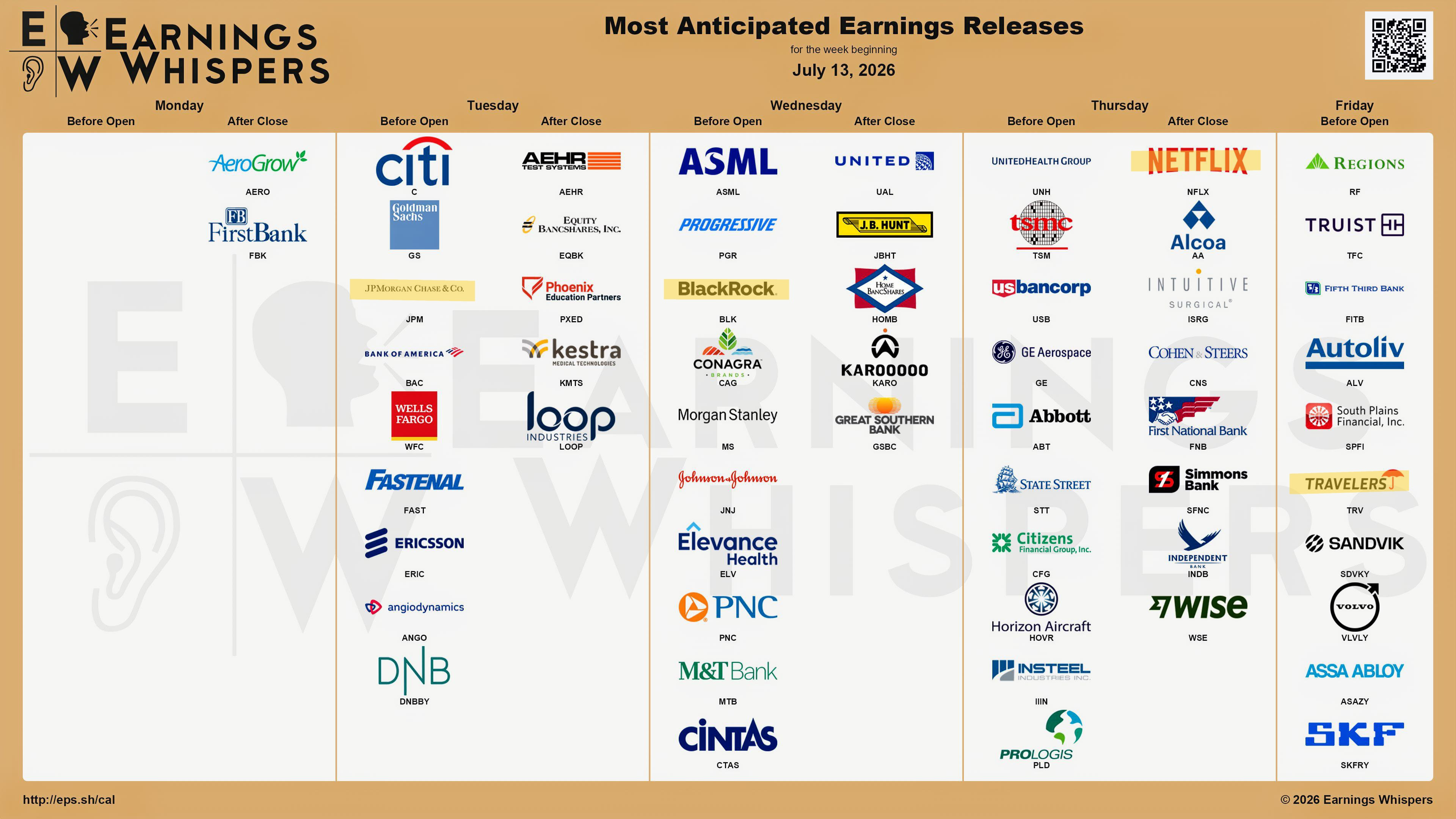
These are the dog days of summer, but I sense an uptick in news coming with earnings season, which by the way starts next week already. We do not get much of a break between seasons, and hopefully we will get the hyperscalers reporting on separate days this time. Below is the earnings calendar snapshot for next week, and I have highlighted the stocks I own and plan to cover closely.
Thank you all for reading, watching, listening, and supporting the Rigatoni Capital newsletter. Have a wonderful weekend and get some rest!
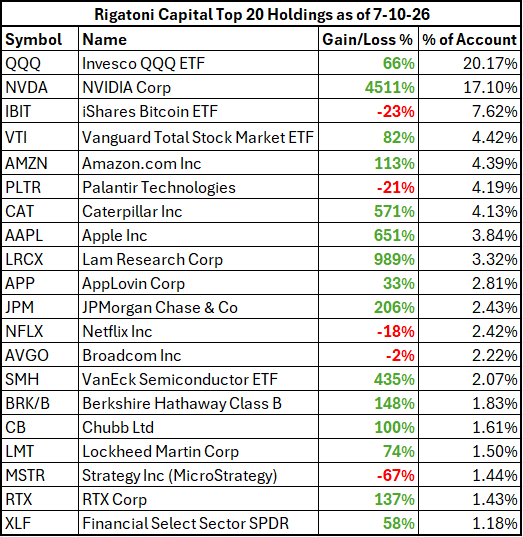
Top Holding as of July 10th
In Case You Missed:


Sources and references:
Meta, Muse Spark 1.1 launch, July 9, 2026, via the Meta AI blog, Bloomberg, Reuters, and TechCrunch, including API pricing of $1.25 per million input tokens and $4.25 per million output tokens.
Torsten Slok, Apollo Global Management, The Daily Spark, on the four hyperscalers projecting a free cash flow acceleration by 2028 and the risks from falling token prices and gains by Chinese open-weight models. Hyperscaler 2026 capex approaching $700 billion, with Bank of America noting big tech is now about as capital-intensive as oil companies.
Starbucks building in-house AI software to replace Microsoft and IBM applications, via Bloomberg and Fortune, including roughly $400 million in annual software spend, about $30 million in budget cuts this fiscal year, and a $2 billion cost-cutting target.
The strongest El Niño in 75 years and its food supply chain risks, including a 97% chance of lasting into early spring 2027 and commentary from Goldman Sachs commodities research.
Netflix exploring live TV channels and bundles, via The Wall Street Journal citing Nielsen, with US TV viewership share falling to 7.8% in April, the lowest since May 2025, and the stock down more than 40% over the past year.
Love your recent pictures 👌☺️